
NASA Announces Artemis III Crew for Critical Moon Mission Test Flight

NASA Announces Artemis III Crew for Critical Moon Mission Test Flight
NASA has officially introduced the four astronauts selected for the upcoming Artemis III mission, a major step in the agency’s long-term plan to return humans to the Moon. The mission, currently targeted for launch in late 2027, will focus on testing key technologies and procedures needed for future lunar landings.
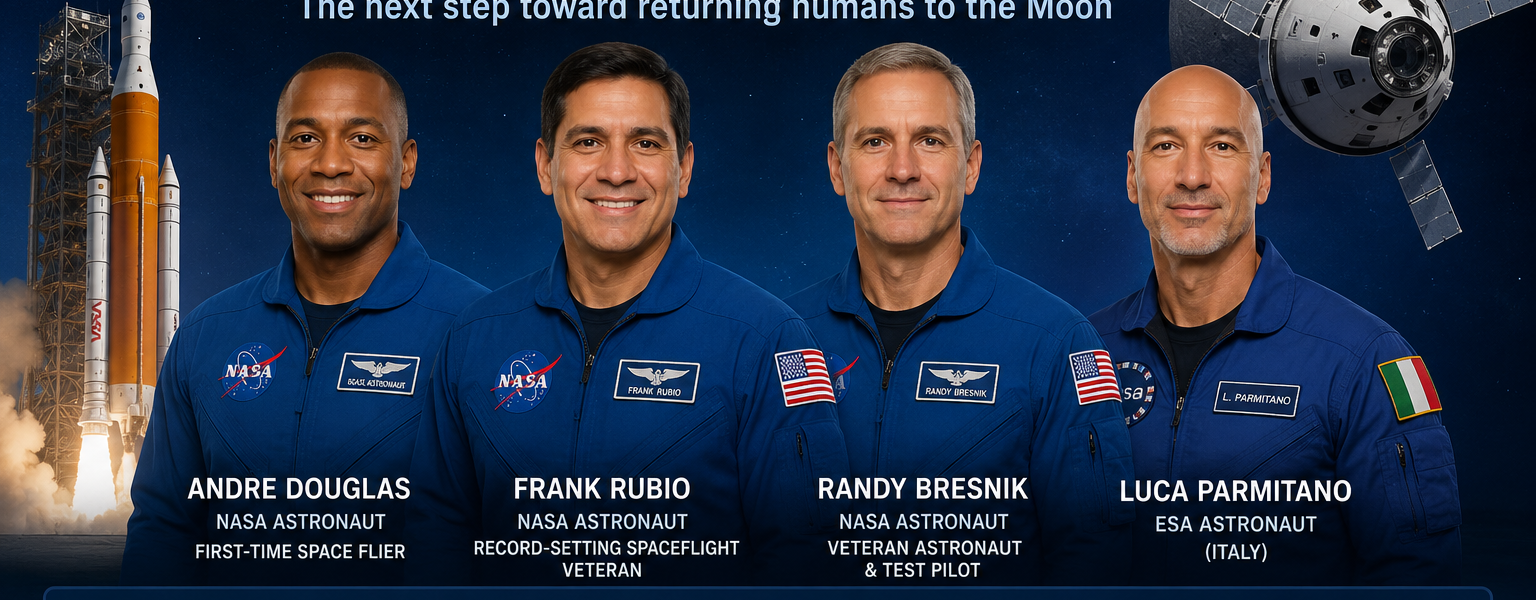
The crew includes NASA astronauts Andre Douglas, Frank Rubio, and Randy Bresnik, along with European Space Agency astronaut Luca Parmitano. For Douglas, the mission will mark his first journey into space, while the other crew members bring extensive experience in human spaceflight.
Unlike a traditional Moon landing mission, Artemis III is designed as a technology demonstration and risk-reduction flight. NASA plans to use the mission to test how its Orion spacecraft can dock with a lunar lander in space, a critical maneuver that astronauts will eventually perform in lunar orbit before descending to the Moon’s surface.
The astronauts will launch aboard the Orion spacecraft from Florida and enter low-Earth orbit, the same region of space where the International Space Station operates. During the mission, one or more lunar landers will launch separately and rendezvous with Orion.
NASA has not yet confirmed which lunar lander will participate. Possible candidates include SpaceX’s Starship lunar lander, Blue Origin’s Blue Moon lander, or potentially both. Once in orbit, the spacecraft will attempt docking operations, allowing astronauts to transfer between vehicles and evaluate systems needed for future Moon missions.
The agency has emphasized that the primary objective of Artemis III is to ensure the safety and reliability of procedures required for human lunar exploration. By conducting these tests close to Earth, NASA hopes to identify and resolve potential challenges before attempting a full Moon landing mission.
NASA’s broader Artemis program aims to establish a sustainable human presence on and around the Moon. If Artemis III achieves its goals, the agency could move forward with a crewed lunar landing mission as early as 2028, marking humanity’s return to the lunar surface for the first time since the Apollo era more than five decades ago.
As competition intensifies between SpaceX and Blue Origin to provide NASA’s next-generation lunar landers, Artemis III is expected to play a pivotal role in shaping the future of deep-space exploration and the next chapter of human journeys beyond Earth.