
M&M’s Maker Scraps Two Iconic Colors Amid Push to Remove Artificial Dyes
Mars Takes a Major Step Toward Natural Ingredients
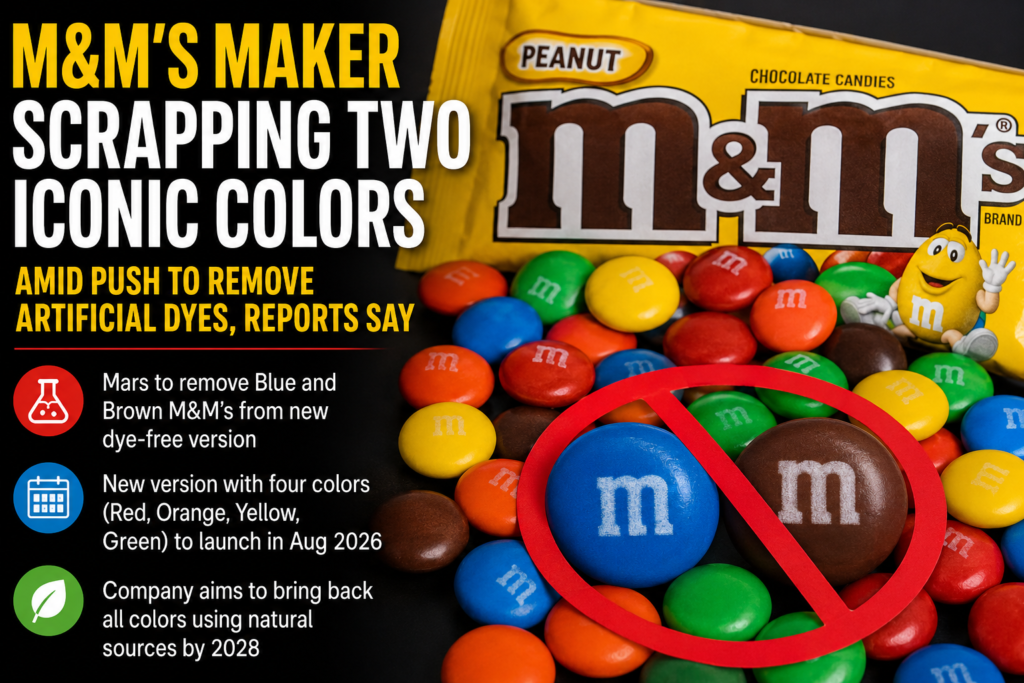
Mars Inc., the company behind the world-famous M&M’s candy brand, is reportedly preparing to remove two of its most recognizable colors as part of a broader effort to eliminate artificial food dyes from its products. According to recent reports, the iconic Blue and Brown M&M’s will be temporarily removed from a new dye-free version of the candy while the company continues searching for suitable natural color alternatives.
The move comes as consumer demand for cleaner ingredients continues to grow and food manufacturers face increasing pressure to replace synthetic additives with naturally sourced alternatives. Mars’ decision reflects a larger trend across the food industry, where companies are investing heavily in reformulating products to meet changing consumer expectations.
Why Are Blue and Brown Being Removed?
While replacing artificial colors with natural alternatives may sound simple, the process is far more complicated than many consumers realize. Mars has reportedly succeeded in developing natural replacements for several M&M’s colors, including red, orange, yellow, and green. However, creating stable and visually appealing natural versions of blue and brown has proven significantly more challenging.
Blue has long been one of the most difficult colors to produce naturally in food products. Artificial blue dyes provide a vibrant appearance and remain stable throughout manufacturing, packaging, and storage. Natural alternatives, however, often fade, change color, or create production challenges.
Reports indicate that Mars experimented with spirulina-based coloring, a natural pigment derived from blue-green algae. Although spirulina can create a blue hue, it reportedly caused issues in manufacturing equipment and affected production efficiency. As a result, the company has not yet found a commercially viable solution that meets both quality and operational requirements.
Brown has also presented challenges due to the need to maintain consistent color appearance while avoiding artificial ingredients. Rather than compromise product quality, Mars has chosen to temporarily exclude both colors from its upcoming dye-free product launch.
New Dye-Free M&M’s Expected in 2026
According to reports, Mars plans to introduce a new dye-free version of M&M’s beginning in August 2026. The initial release will feature only four colors: red, orange, yellow, and green.
The absence of blue and brown has generated considerable discussion among consumers, as both colors have become closely associated with the M&M’s brand. Blue M&M’s, in particular, hold a special place in the product’s history after being introduced in the 1990s following a highly publicized consumer voting campaign.
Despite their temporary removal, Mars has emphasized that the decision is not permanent. The company reportedly aims to bring back all traditional colors once suitable natural alternatives are developed and tested.
A Multi-Million-Dollar Investment
Transitioning away from artificial dyes requires extensive research, testing, and manufacturing upgrades. Industry reports suggest that Mars has invested millions of dollars into the project and assembled a large team of scientists, engineers, and food specialists dedicated to solving the challenges associated with natural color production.
The company has also been forced to adapt certain manufacturing processes to accommodate natural ingredients, which often behave differently from synthetic dyes. Maintaining consistency, color vibrancy, and shelf stability remains a major hurdle for food manufacturers pursuing cleaner ingredient lists.
While the investment is substantial, Mars views the effort as an important step toward aligning its products with future consumer preferences and industry standards.
Growing Pressure to Remove Artificial Dyes
The decision comes amid increasing scrutiny of artificial food dyes in the United States and other markets around the world. Consumer advocacy groups, health organizations, and policymakers have raised concerns about synthetic food colorings and their potential effects, particularly in products marketed to children.
In recent years, many food brands have announced initiatives to reduce or eliminate artificial ingredients from their products. The movement has gained additional momentum through campaigns promoting healthier food choices and greater transparency in food manufacturing.
As one of the largest confectionery companies in the world, Mars faces growing expectations from consumers who increasingly prioritize ingredient quality alongside taste and appearance.
The company has already explored dye-free options across various brands within its portfolio, including M&M’s, Skittles, and Starburst. These efforts reflect a broader industry shift toward natural formulations.
Will Traditional M&M’s Disappear?
For fans worried about losing their favorite candy, there is good news. Reports indicate that traditional M&M’s are not being discontinued. Instead, the new dye-free version will initially be offered as an additional product option.
Consumers will still be able to purchase classic M&M’s while Mars evaluates market response to the naturally colored alternative. This approach allows the company to test consumer demand without completely replacing its existing product lineup.
Industry analysts believe this strategy reduces risk while giving Mars valuable insight into whether consumers are willing to embrace candies that may look slightly different from the products they have enjoyed for decades.
Consumer Reactions on Social Media
News of the color changes has sparked widespread discussion online. Some consumers have praised Mars for taking steps toward cleaner ingredients and reducing reliance on synthetic additives. Others, however, have expressed disappointment about the temporary loss of two beloved colors.
Many longtime fans have highlighted the cultural significance of Blue M&M’s, recalling the brand’s famous color election campaign that helped introduce the character to consumers in the mid-1990s. Others have questioned whether the candies will feel the same without the full rainbow of colors that has become synonymous with the M&M’s experience.
Despite the mixed reactions, most consumers appear interested in seeing how the new version performs once it reaches store shelves.
What This Means for the Future of Candy
The M&M’s color change represents more than just a product update. It highlights a growing transformation across the global food industry, where ingredient transparency and natural sourcing are becoming increasingly important competitive factors.
Food manufacturers face a delicate balancing act: consumers want simpler ingredients, but they also expect products to maintain the same taste, appearance, and overall experience. Achieving both goals often requires years of research and significant financial investment.
Mars’ efforts could serve as a blueprint for other confectionery companies facing similar challenges. If the dye-free M&M’s launch proves successful, it may encourage more brands to accelerate their own transitions away from artificial colors.
Conclusion
Mars’ decision to temporarily remove the iconic Blue and Brown M&M’s colors marks a significant milestone in the company’s journey toward eliminating artificial dyes. While the change may disappoint some fans, it reflects broader consumer demand for cleaner ingredients and more natural food products.
The company’s commitment to eventually restoring all traditional colors using natural alternatives demonstrates the complexity of food innovation in today’s marketplace. For now, consumers can expect a new dye-free M&M’s experience featuring red, orange, yellow, and green candies, while Mars continues working toward bringing back the beloved blue and brown colors.
As the food industry evolves, the success of this initiative could influence how major brands approach product reformulation in the years ahead.